
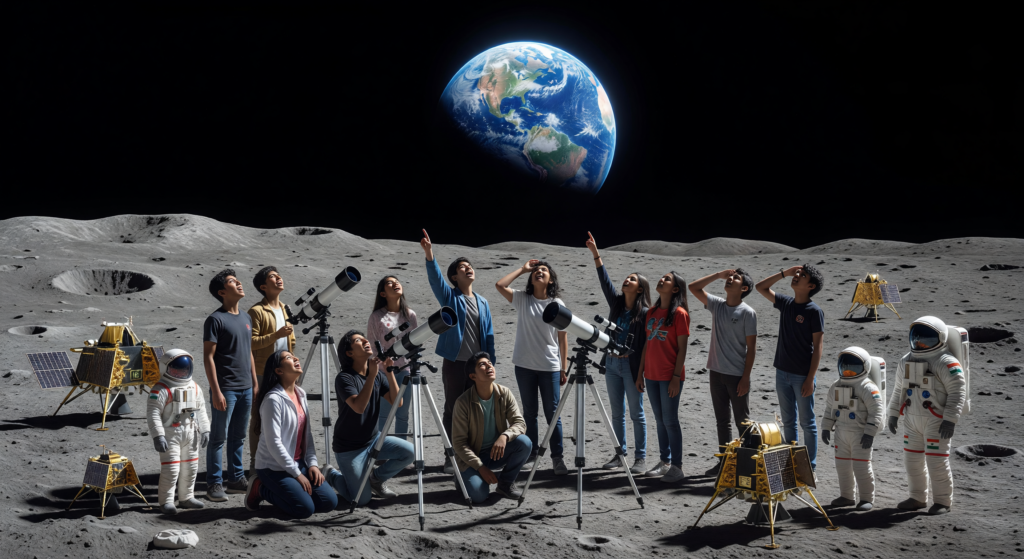
The Artemis II Mission: India’s Role in Lunar Exploration
The moon has always captivated humanity, and now, a new chapter in lunar exploration is unfolding. NASA’s Artemis II mission represents a significant milestone in space exploration, marking humanity’s return to lunar orbit with a crewed spacecraft. For Indian teenagers passionate about science and space, this mission opens up exciting possibilities and opportunities to contribute to the future of space exploration.
What is the Artemis II Mission?
The Artemis II mission is NASA’s ambitious endeavor to send astronauts around the moon for the first time in over five decades. The crew lifted off from the Kennedy Space Center in Florida, embarking on a 10-day journey that will take them around our celestial neighbor and back to Earth. This mission serves as a crucial stepping stone for future lunar landings and deeper space exploration.
Unlike the Apollo missions of the past, Artemis II is part of a broader program designed to establish a sustainable human presence on and around the moon. The mission tests critical systems, gathers valuable data, and prepares the groundwork for Artemis III, which aims to land astronauts on the lunar surface.
Why the Moon Matters
The moon isn’t just a beautiful object in the night sky—it’s a gateway to understanding our solar system and beyond. Lunar exploration helps scientists:
- Study the formation and evolution of planetary bodies
- Test technologies needed for Mars missions
- Search for water ice that could support future lunar bases
- Develop new materials and methods in the unique lunar environment
India’s Growing Space Presence
India has already established itself as a formidable player in space exploration. The Indian Space Research Organisation (ISRO) has successfully launched missions to the moon and Mars, demonstrating technical expertise and innovation at a fraction of the cost of other space agencies. This efficiency and ingenuity make India an attractive partner for international space collaborations.
As global space agencies recognize the value of international cooperation, opportunities for India to contribute to lunar missions continue to expand. From developing specialized instruments and rover technologies to providing launch services and ground support, India’s space sector is positioned to play meaningful roles in future Artemis missions and other lunar exploration programs.
Opportunities for Indian Teens in Space Science
The exciting developments in lunar exploration create numerous pathways for young Indians interested in space science. The field encompasses much more than just becoming an astronaut—though that’s certainly an option too.
Engineering and Technology
Spacecraft design, propulsion systems, life support technologies, and robotics all require skilled engineers. Indian institutes are increasingly offering specialized programs in aerospace engineering and related fields, preparing students to work on cutting-edge space projects.
Data Science and Computing
Modern space missions generate enormous amounts of data that need analysis. From processing images captured by lunar orbiters to developing artificial intelligence systems for autonomous rovers, computational skills are invaluable in space exploration.
Materials Science and Chemistry
Understanding how materials behave in space environments, developing new alloys for spacecraft construction, and analyzing lunar soil samples all fall within these disciplines. These fields are critical for building sustainable lunar habitats and utilizing lunar resources.
Astronomy and Planetary Science
Scientists who study celestial bodies, their composition, and their behavior help plan missions and interpret findings. India’s contributions to space telescopes and observational astronomy continue to grow, offering research opportunities for aspiring astronomers.
Building the Foundation Today
For teenagers dreaming of contributing to space exploration, the journey begins with strong fundamentals in science and mathematics. Participating in science clubs, astronomy societies, and robotics competitions provides practical experience and builds problem-solving skills essential for space-related careers.
Many Indian universities and research institutions now offer internship programs and outreach initiatives that connect students with real space projects. Online courses and resources have also democratized access to space science education, allowing motivated learners from any background to acquire knowledge and skills.
International Collaboration: The Future of Space Exploration
The Artemis program exemplifies how international partnerships drive space exploration forward. As missions become more complex and ambitious, no single nation can accomplish everything alone. India’s proven track record in space technology, combined with its growing scientific community, positions the country as a valuable partner in future lunar endeavors.
This collaborative approach means that Indian scientists, engineers, and researchers will increasingly work alongside international teams, contributing unique perspectives and innovations to shared goals.
Conclusion
The Artemis II mission represents more than just a return to the moon—it symbolizes humanity’s commitment to pushing the boundaries of exploration and knowledge. For Indian teenagers, this era of renewed lunar exploration offers unprecedented opportunities to participate in one of humanity’s greatest adventures.
Whether through engineering, science, technology, or research, the pathways to contributing to space exploration are diverse and accessible. As India continues to strengthen its space capabilities and international partnerships deepen, the next generation of Indian space professionals will play crucial roles in writing the next chapters of lunar exploration. The journey to the moon—and beyond—is just beginning, and there’s room for passionate, dedicated young minds to help shape that future.